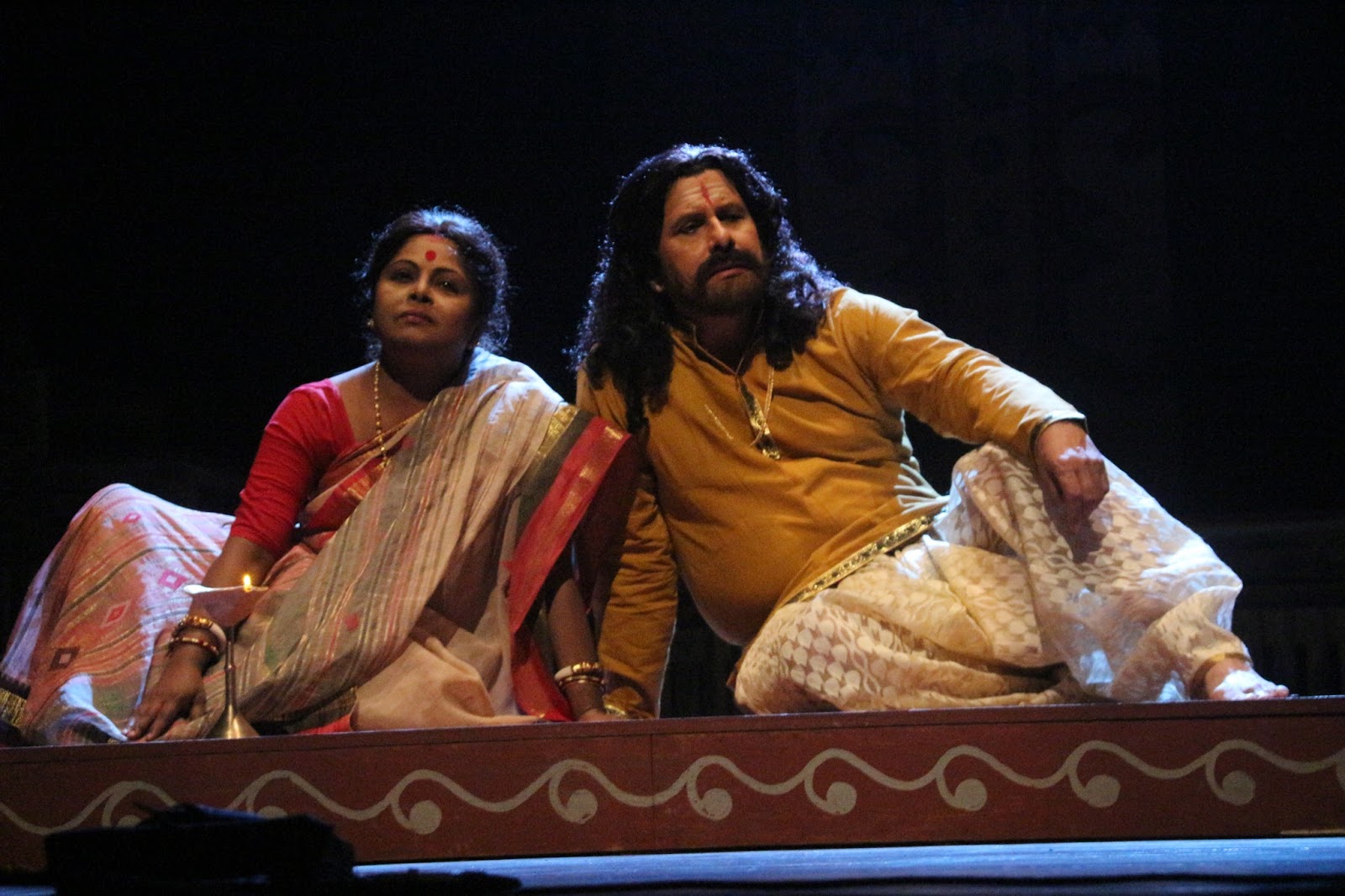
MANASAMANGAL


MANASHAMANGAL

First Show Held : August 11, 2016, 6.30 PM at EZCC, Purbasree, Salt lake,Kolkata,
Duration of Play : 2 Hrs 10 Mins (With an interval of 10 Mins.)

The story of Manasamangal begins with the conflict of the merchant Chandradhar with Manasa and ends with Chandradhar becoming an ardent devotee of Manasa. Chandradhar is a worshipper of Shiva, but Manasa hopes that she can win over Chand to her worship. But, far from worshipping her, Chand refuses to even recognize her as a deity. Manasa takes revenge upon Chand by destroying six of his ships at sea and killing his six sons. Chand revived and set out on another sea voyage to rebuild his business. ButagainManasa swept him ashore from the mainstream of life. Chand became a beggar and lost everything but still worshiped only Shiva and refusing to bow to Manasa.

A son was born to himnamedLakshmindara.Chand returned to Champak Nagar and managed to rebuild his life. Chand arranged marriage of Lakhindara with Behula. In spite of all precautions, Manasa had her way — a snake, sent by her, killed Lakshmindara. The rest of the story is a tale of how Behula combated against all odds and adversitiesand finally succeeded in bring back Lakhindara in life. Chand could not forgive the goddess for all the suffering he had to go through. He offered her flowers with the left hand and turned his face away from her image. From then on Chand and his family lived in peace and prosperity.


Director’s Note
Manasamangal is basically the tale of oppressed humanity. Chandradhar and Behula have been portrayed as two strong and determined characters at a time when ordinary human beings were subjugated and humiliated. The epic brings out the caste divisions and the conflicts between Aryans and non-Aryans. The conflict between human beings and the goddess brings out the social discriminations of society, as well as the conflict between Aryans and non-Aryans. Shiva, whom Chand worshipped, was originally not an Aryan god, but over time was elevated to that position.

Manasa's victory over Chand suggests the victory of the indigenous or non-Aryan deity over the Aryan god. However, even Manasa is defeated by Behula. The play thus suggests not only the victory of the non-Aryan deity over the Aryan god, but also the victory of the human spirit over the powerful goddess. Manasamangal is also remarkable for its portrayal of Behula who epitomises the best in Indian womanhood, especially the Bengali woman's devotion to her love.
Nandipat has been working in the performing art field for the last 37 years. Ever since its inception, the troupe never created any musical play. Besides, Manasamangal has a strong cultural flavor of Bengal in epic format, which has every possibility of expressing localized folk-art form. Moreover, this is a story of humanity and battle against power politics. Thus I felt the necessity of disseminating the message of true power of tolerance and the fighting spirit of Behula in today’s generation.


Credit

Play                                      :      Ujjwal Chattopadhyay
Scenic design                       :      Sandip Suman Bhattacharya
Music                                   :      Subhadip Guha
Lighting design                    :      Soumen Chakraborty
Costume design                   :      Poushali & Sanmitra
Make-up                               :      Md. Ali
Choreographer                     :      Deb Kumar Pal
Direction                              :      PROKASH BHATTACHARYA


Cast

Sanjita Mukherjee
Manasha
Monalisa Chatterjee
Behula
Sarbani Bhattacharya
Sanaka
Poulami Banerjee
Narrator
SrimoyeeMitra
Kalnagini
Bani Das
Chandi
Sikha Sarkar
Neta
Mandira
Narrator
Jayanti Saha
Amala
Shankar Mukherjee
Shay Bena
Shilajit Naskar
Jagati
Triguna Shankar Manna
Lakhindara
Sukhendu Prasad Bangal
God
Shankar Mukherjee
Goda
RajdeepChakraborty
Viswakarma
Pintu Das
Dhanwantari
BimalChakraborty
Chand Saudagar
SayanDebnath
Narrator
Sanjib Chowdhury
Nera
Shirshendu Sarkar
Narrator
IshanjitDey
God
Arka Banerjee
God
Pintu Das
Baidya
Biplab Naha Biswas
Lord Shiva
Ashis Das
Bonkoraj Khuro
Sandip Suman Bhattacharya
Indra 


O Chand (Oh! Moon)


O Chand (Oh! Moon)

The play, O Chand (Oh! Moon) has been developed with a tale of another middle class family in the context of political terror. The only earning source of the family, Atri, a teacher by profession, a nature lover, got victimized in the altercation between the State and the political extremists. He was an affectionate son of a visually impaired woman, a caring husband, a father of an adorable daughter. His romance for the nature, thirst for drinking to the drag the beauty of flora and fauna had been driven him from hills to the coastal fronts of the country. The aroma of happy ambience of the family, which includes music of nature, the tune and voice of his beloved mother, the flavor of the religious sacraments at the full-moon night, had haunted him since his very childhood. He felt the irresistible affinity towards the beauty of nocturnal blue of full-moon night — the affinity which ultimately pulled him to the battlefield in the Left Wing Extremism affected area. Based on a misperception he got abducted by the so called revolutionist guerrillas. A rebel by nature against the social and economic injustice he stood erect against the ideology of the political extremists, who declared war against the State power. His fatal end brutally affected his family. The play, based on a real life incident, raised the concern of adverse impact of such civil war at the micro level of the society. 


RAI in "O Chand"


Director’s Note

The strategy of using ‘Terror’ as the fundamental weapon for regulating the opinions of civil society has effectively been adopted by the political activists. After the naxalite movement of the seventy’s decade of last century, political terror in West Bengal has prominently been surfaced with the emergence of Left Wing Extremism in the southern part of the State. It is quite evident in parliamentary democracy thatthe political parties, irrespective of their colours, have frequently been utilised ‘terror mechanism’ to achieve their objectives. The goal of political violence is for one group to gain political power over another. The sympathizers in support of the political revolutionists try to justify the so-called socio-political terror as the struggle of marginalized people for their utter survival— they chose violence after long deliberation, because they felt they had no choice. But what about the political terrors created by the so-called non-marginalized groups?

However, the common people,the society as a whole, especially the poor and middle class families are most the vulnerable and are at stake due to the effects of such Political violence.They are the ultimate sufferers. According to a source of information, a total of 6510 persons died due to Left wing extremism in India during 2005 to 2014, of which 2688 are civilians. Death is the most obvious and permanent form of separation. Separation from the other family members, separation from the other associates, — separation that can ruin the entire family infrastructure. In the context of long prevailing political unrest situation in West Bengal we are witnessing plenty of cases of similar separations regularly from their families, friends and other associates just because of political violence. In this context, the play ‘O Chand’ has a tremendous social relevance today.


CREDIT :


Production : NANDIPAT
Play : Debotosh Das
Scenic Design : Sandip Suman Bhattacharya
Lighting Scheme : Badal Das
Music Editing : Swapan Bandyopadhyay
Make-up : Tapan Chakraborty
Costume : Pintu Das
Sound Operation : Himangshu Pal
Light Operation : Deepak Dev
Kirtan Recital : Srija Chakraborty
Voice : Anjan Roy CHowdhury
Music Scheme &
Directed by Saumitra Poddar 


A SCENE FROM "O CHAND"

CAST :

Atri : Saumitra Poddar
Aditi : Monalisa Chatterjee
Rai : Kinkini Maity
Mother : Sarbani Bhattacharya
Abbas : Biplab Naha Biswas
Sunanda : Sanjay Das
Rahul : Bikashkali Ghosh
Chandi Da :  Sandip Suman Bhattacharya
Tiger : Shyamal Chakraborty
Kartik : Anjan Roy Chowdhury
Commander : Partha Pratim Das
Rebel : Triguna Shankar Manna
Guerrillas : Saikat Bhattacharya,
Bikashkali Ghosh, Moumita Ghosh, Asish Saha,
Manojit Dey, Sukhendu Prasad Bangal